HS Codes and Japan's Tariff Schedule
How pork is coded and taxed at Japan's border
0203.22: frozen bone-in hams, shoulders and cuts thereof, of swine. These six digits mean the same thing in Japan, the United States and Spain. Japan's import declarations, however, use nine digits, such as 0203.22-022, and the last three are set by Japan alone. This numbering system is the HS code, and Japan's tariff schedule lists the duty rates that may apply to each code.
What is an HS code?
The Harmonized System (HS) is the product classification used in international trade. It is based on an international convention administered by the World Customs Organization (WCO), in force since 1988. The convention has 163 contracting parties, and more than 200 customs administrations, including some outside the convention, use the system, so nearly all world trade is classified by these codes.
The code is hierarchical.
Click Chapters 02, 05 or 16 to switch the lists to that chapter. Headings, subheadings and statistical codes are clickable too
The first six digits are international; anything beyond is national. This is the basic dividing line when working with HS codes. Which code a product belongs to is decided by rules: notes at the start of each chapter set its boundaries, and six General Interpretative Rules govern classification. Because all contracting parties follow the same rules, comparisons across countries hold up to six digits.
※ The HS is revised about every five years to keep up with trade. The current edition is HS 2022; HS 2028 is scheduled to take effect in January 2028.
National subdivisions beyond six digits
Beyond the first six digits, each country adds its own subdivisions for setting duty rates and collecting statistics. The number of digits and the criteria vary by country.
| Country and system | How 0203.22 is split |
|---|---|
Japan Statistical Code for Import (tariff schedule), 9 digits | By price per kilogram Above the gate price (022) and three bands below it (023, 024, 025). Wild boar has its own line (010) |
United States HTS, 10 digits | Processed or not Processed (0203.22.10, 1.4¢/kg) / other (0203.22.90, free). Schedule B for exports splits the same way |
EU CN, 8 digits / TARIC, 10 digits | By cut Hams (0203 22 11) / shoulders (0203 22 19). Non-domestic swine have their own line (0203 22 90) |
Canada Customs Tariff, 8–10 digits (statistics: CIMT) | Not split Export statistics use a single code, 0203.22.00 |
Brazil NCM (Mercosur Common Nomenclature), 8 digits | Not split A single code, 0203.22.00 |
Sources: Japan Customs, Japan's Tariff Schedule (October 31, 2026); U.S. International Trade Commission, HTS; U.S. Census Bureau, Schedule B; Eurostat Comext (CN); Statistics Canada, CIMT; Brazil MDIC, Comex Stat
These subdivisions reflect each country's policy needs: which products it wants to tax differently and which it wants to track. Countries subdivide the same product category in very different ways, and Japan even uses separate sets of final three digits for exports and imports. That is why a foreign code often cannot be found in Japan's schedule, and when matching data across countries, the rule of thumb is to compare at six digits.
Japan's tariff schedule
Japan Customs publishes the tariff schedule as a list of nine-digit items and every duty rate that may apply to each. Its full name is Japan's Tariff Schedule (Statistical Code for Import), and trade statistics use the same nine-digit codes.
The legal rates are spread across the Customs Tariff Act, the Act on Temporary Measures concerning Customs and the schedules of each EPA; the tariff schedule pulls them into one working list. It is updated several times a year, usually including January 1 and April 1 editions (many EPAs cut their rates every April 1).
Reading the rate columns
Each nine-digit code comes with a long row of rate columns, and it is not obvious which one to read. This is the actual row for 0203.22.
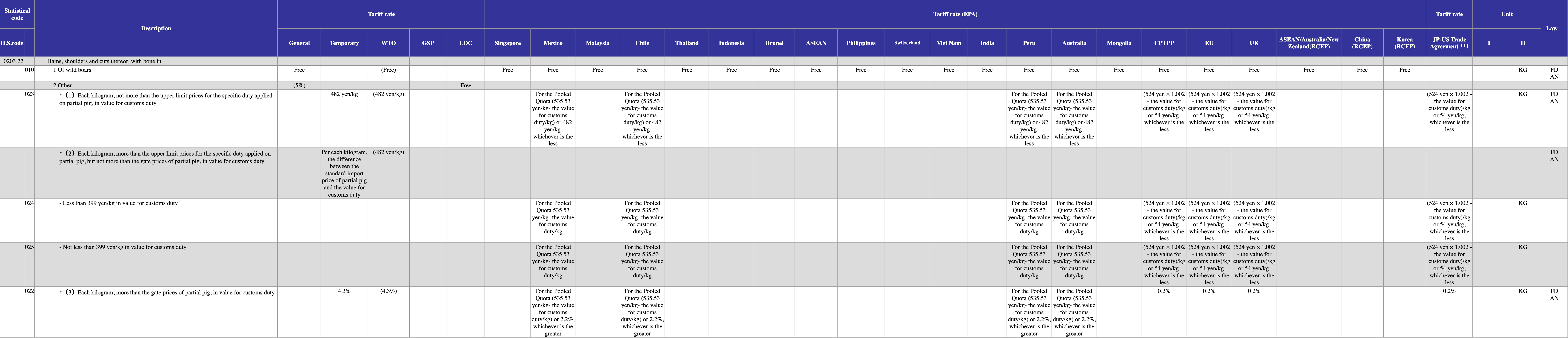
Source: Japan Customs, Japan's Tariff Schedule as of October 31, 2026 (English edition), Chapter 2, rows for 0203.22 (scroll to see all columns)
Goods under the same nine-digit code can face different duty rates depending on their country of origin. The table fits all of these cases into a single row, which is why there are so many columns.
| Stat. code | Description | Tariff rate | 5 Tariff rate (EPA)4 of 22 columns | ||||||||||
|---|---|---|---|---|---|---|---|---|---|---|---|---|---|
| 1 General | 2 Temporary | 3 WTO | 4 GSP | LDC | … | Mexico | … | CPTPP | EU | … | Japan–US Trade Agmt. | ||
| 1602.42 | Shoulders and cuts thereof | ||||||||||||
| 1 Ham or bacon, etc. (omitted) | |||||||||||||
| 090 | 2 Other | 25% | 20% | Free | Free | Free | Free | ||||||
123 Without an agreement rate
Also covers imports from countries with no agreement with Japan, such as 🇧🇷 Brazil
- 1GeneralCustoms Tariff Act the base rate
- 2TemporaryAct on Temporary Measures concerning Customs set for a limited period; where it exists, it replaces the general rate
- 3WTOWTO schedule of concessions used when lower than the general or temporary rate
5 Economic partnership agreements
For goods originating in a partner country, read that agreement's column (one per agreement, 22 in all)
- 🇺🇸 U.S.Japan–US Trade AgreementFree
- 🇨🇦 CanadaCPTPPFree
- 🇪🇺 EUJapan–EU EPAFree
- 🇲🇽 MexicoCPTPPFreeThe Mexico column holds the Japan–Mexico EPA rates (in force since 2005) and is blank for this code. Mexico can also use the CPTPP (since 2018), so read the CPTPP column
In practice, imports from a country with an EPA use that agreement's rate, and imports from a country without one (such as Brazil) use the rate set by ①–③. Most of Japan's main pork suppliers have an EPA with Japan.
Reading the description column
The description column is a hierarchy shown by indentation. Joining the lines from the top gives the full description of a single code. For 0203.22-022, it reads:
Meat of swine, fresh, chilled or frozen › Frozen › Hams, shoulders and cuts thereof, with bone in › Other › Each kilogram, more than the gate prices of partial pig, in value for customs duty
※ “Partial pig” is the schedule's term for cuts, as opposed to carcasses.
Where pork is classified
Pork and related products are spread across several chapters, not just Chapter 2.
Click a code box to see the tariff schedule wording and what it means
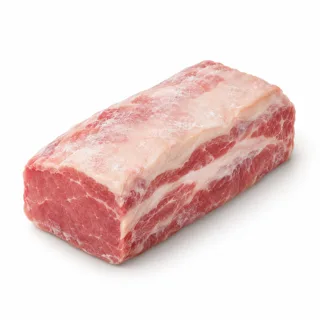
See the tariff schedule wording for all codes
Product images are AI-generated illustrations
02.03 Pork: the last three digits are price bands
In 02.03, the fifth digit gives the temperature, the sixth the cut, and the last three the duty band.
Bone-in hams and shoulders are the only cuts with their own subheadings, and that is true worldwide. HS subheadings are created for products with enough annual trade (a guideline of US$50 million), and bone-in hams and shoulders meet that threshold as a category.
The last three digits show the band of the import price (CIF), and each band is taxed differently.
- ¥64.53 = standard import price (¥546.53) − specific duty (¥482). These thresholds also set the statistical code for imports using EPA rates
- The figure shows cuts. Carcasses use a separate set: 020 (specific), 031/032 (differential; formerly 030) and 040 (ad valorem)
※ US$50 million a year is the WCO's current guideline for creating a new subheading.
※ Import price (CIF): the declared import value, including the goods, ocean freight and insurance (the value for customs duty)
※ There is also a line for wild boar (010, duty-free).
For how each band is taxed, see Japan's Gate Price System. The bands are also used by the safeguard, which tracks import volumes on either side of ¥399/kg (see Japan's Pork Safeguards).
When tracking import volumes over many years, map the old 021 to today's 024 and 025. In the 2020s, with a weak yen and high prices, most imports have come in above the gate price (022). Imports in the differential duty bands (024 and 025) keep shrinking, and 023 remains a code but records almost no imports.
Same chart as “Imports by tariff band” on the Japan imports dashboard (chilled + frozen, all cuts), updated with each monthly release of Japan's trade statistics.
02.06 and 05.04: separate chapters for red and white offal
What the trade calls red offal (heart, liver and other organs) falls under 02.06; white offal (guts, stomachs and bladders) falls under 05.04 (see Reference).
Japan's statistical codes under 05.04 do not separate pigs from other animals, so pig white offal is counted together with other species.
Red offal (02.06) has separate codes for chilled and frozen products, but almost all imports are frozen, mainly liver and other organs.
※ For this reason, the PorkLens dashboards do not show white offal or chilled red offal.
02.09 Pig fat: unrendered fat only
Under Note 1(d) to Chapter 2, animal fat belongs in Chapter 15, except products of heading 02.09. The dividing line is whether the fat has been rendered: unrendered pig fat free of lean meat (fresh, chilled, frozen, salted, in brine, dried or smoked) falls under 02.09, and rendered pig fat (lard) under 15.01.
The wording of 02.09 does not specify a part of the pig, but most imports are back fat.
Chapter 16: cooked and seasoned pork (GSP and others)
Meat processed beyond the scope of Chapter 2, for example by seasoning or cooking, falls under Chapter 16: sausages and similar products under 16.01, and other preparations under 16.02.
Within 16.02, most pork comes in under "shoulders and cuts thereof › other" (1602.42-090), at 110,000 to 120,000 tonnes a year. The wording describes prepared shoulders, but most of these imports are what the trade calls GSP (ground seasoned pork): ground pork seasoned with pepper.
※ GSP is made mostly from picnic shoulder.
Adding seasoning to ground pork does not by itself move it to Chapter 16. Under Japan Customs' national classification rules (in Japanese), meat seasoned only with salt and pepper falls under Chapter 16 when the added pepper is clearly detectable by analysis (about 0.3% pepper as a guide) and the product has a reasonable seasoned taste; meat seasoned with salt alone stays in Chapter 2.
GSP is used mainly as a raw material for sausages and other processed products. It falls outside the gate price system and carries an ad valorem duty (20% at the WTO rate), but imports from the main suppliers (the U.S., Canada, Mexico, Chile and the EU) enter duty-free under EPAs.
Same charts as the “Specific-duty items” tab of the Japan imports dashboard (HS 1602.42-090), updated with each monthly release of Japan's trade statistics.
Most imports come from major pork exporters such as the United States, Canada, Chile, Mexico and Denmark, at similar unit values. Some imports also come from countries such as China, which cannot export fresh or frozen pork to Japan for animal health reasons. These imports have distinctly different unit values, suggesting that they are cooked products.
※ Under Japan's Act on Domestic Animal Infectious Diseases Control, meat products from countries otherwise barred can be imported if they are heat-treated at a facility designated by Japan's agriculture minister and accompanied by an inspection certificate from the exporting country's government.
When it is unclear whether a product belongs in Chapter 2 or Chapter 16, its classification can be checked with Japan Customs before import (an advance ruling; see Reference).
Why exporting countries' statistics can differ from Japan's
The same goods can be recorded under different codes in an exporting country's export statistics and in Japan's import statistics.
The main example is the United States. Seasoned meat such as GSP is recorded under 16.02 (preparations) in Japan's import statistics, but appears to be recorded under 02.03 (frozen pork) in U.S. export statistics. Comparing U.S. exports to Japan with Japan's imports from the U.S., chilled pork volumes are similar. The U.S. figure is higher for frozen pork and Japan's figure is higher for preparations by about the same amount, so the totals are similar.
| Product | U.S. exports to Japan | Japan's imports from the U.S. | Difference |
|---|---|---|---|
| Chilled(0203.11–19) | 140 | 137 | +2 |
| Frozen(0203.21–29) | 126 | 64 | +62 |
| Preparations(1602.42, 1602.49) | 36 | 92 | −56 |
| Total | 302 | 293 | +9 |
Sources: U.S. Census Bureau (exports, Schedule B); Ministry of Finance, Trade Statistics of Japan
※ The same pattern has held every year since 2016: the U.S. figure for frozen pork is higher by roughly 50,000–100,000 tonnes, and the Japanese figure for preparations by about the same. There is no official explanation; this is inferred from the volumes.
Beyond six digits, as the 0203.22 table shows, countries split codes along different lines. The United States, for example, splits by whether the meat is processed, so U.S. statistics cannot separate bone-in hams from shoulders.
Differences in trade terms (FOB vs. CIF) and in recording dates also come into play. When comparing statistics across countries, keep in mind that codes may not match one to one, and combine several codes where needed.
Where to check classifications and rates
| Source | What it covers |
|---|---|
| Japan Customs — Japan's Tariff Schedule | Every nine-digit item with all rate columns; past editions archived (English edition for reference) |
| Japan Customs — Explanatory Notes and classification rulings (Japanese) | Japanese translation of the WCO Explanatory Notes and Japan's classification precedents |
| WCO Trade Tools | The official HS nomenclature (all editions, English) |
| WTO Tariff & Trade Data | Applied and bound rates by country |
| ITC Market Access Map | MFN and preferential rates, searchable across countries |
Key points
- HS codes are common worldwide up to six digits, and each country subdivides beyond that. Classification decisions can also differ by country, so exporting countries' statistics and Japan's import statistics do not always use the same code.
- Japan's tariff schedule lists several rates for each item; which one applies depends on the country of origin and whether it has an EPA with Japan.
- Pork products fall under different chapters depending on the processing method and the part of the animal. Within 02.03, the code also depends on the import price. The classification determines the duty rate and the import requirements.
Advance rulings
If a product is classified under a different code than expected, a different duty rate or different import requirements may apply. Japan Customs' advance ruling system lets importers and other relevant parties ask for the classification and duty rate before the goods are imported. A written ruling is respected by customs when the import declaration is examined, and it is valid for three years.
For pork, classification questions often concern the boundary between Chapter 2 (meat) and Chapter 16 (preparations), which depends on the degree of seasoning or processing. In one published ruling, frozen pork tenderloin injected with and marinated in a seasoning liquid was judged to be "frozen pork, insufficiently seasoned" and classified under 0203.29-023 (meat, under the gate price system) rather than Chapter 16.
A search of the ruling database for pork mainly returns sausages and preparations (Chapter 16), along with frozen pork classified in Chapter 2 based on its degree of seasoning. The boundary is a recurring classification question.
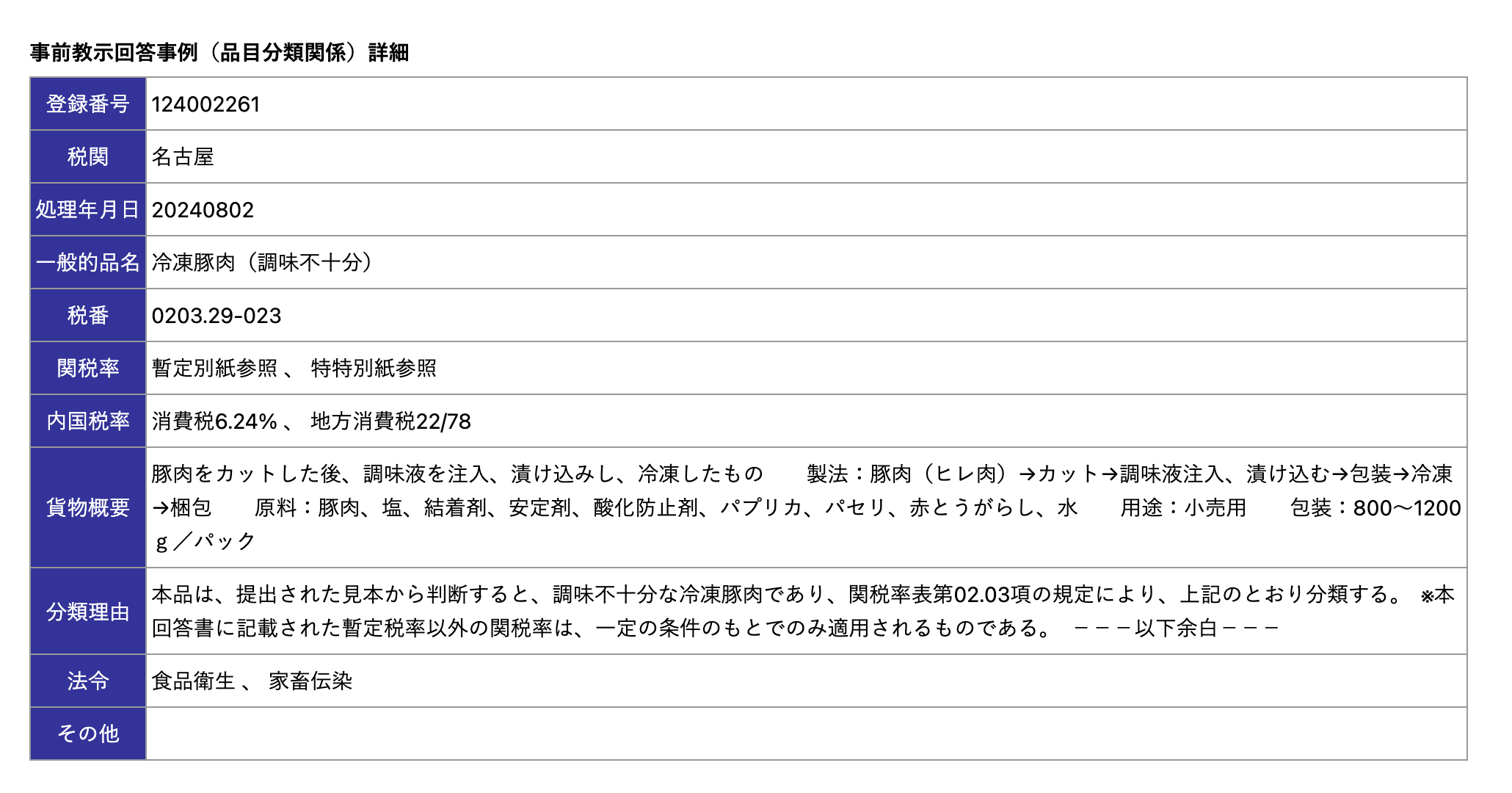
Source: Japan Customs, advance ruling (tariff classification) no. 124002261, in Japanese. It records the product as frozen pork (insufficiently seasoned), code 0203.29-023: tenderloin cut, injected with and marinated in a seasoning liquid, and frozen. The reason given is that, judging from the sample submitted, the product is insufficiently seasoned frozen pork and falls under heading 02.03.
※ The request form asks for the manufacturing process and composition, with samples or analysis results attached as needed. Published rulings can be searched (in Japanese) in Japan Customs' advance ruling database.
How red and white offal are separated
The split follows from the chapter notes. In order:
- First, Note 1(c) to Chapter 2 excludes guts, bladders and stomachs of animals from Chapter 2 and points them to heading 05.04 → white offal goes to Chapter 5
- Next, Note 1(a) to Chapter 5 excludes edible products from Chapter 5 but makes an exception for guts, bladders and stomachs, which stay in 05.04 → white offal falls under 05.04
- Finally, edible organs that Chapter 2 does not exclude count as edible offal and fall under 02.06 (Japan's additional note 1 to Chapter 2: offal includes organs) → red offal falls under 02.06
The data in this article is available on this dashboard.
- WCO — What is the Harmonized System?
- WCO — Guidance on how to submit a Harmonized System Change Proposal
- WCO — HS Nomenclature 2022, Chapter 2 (notes)
- WCO — HS Nomenclature 2022, Chapter 5 (notes)
- Japan Customs — Japan's Tariff Schedule as of October 31, 2026 (English edition)
- Japan Customs — Tariff schedule as of October 31, 2026 (Japanese, official text)
- Japan Customs — Customs Answer 1202: Advance Ruling on Tariff Classification
- Japan Customs — Advance ruling no. 124002261: frozen pork, insufficiently seasoned (Japanese)
- Japan Customs — Customs Answer 1105: types of duty rates (Japanese)
- Japan Customs — How the applicable duty rate is determined (Japanese)
- Japan Customs — Explanatory Notes and classification rulings, Chapter 2: criteria for meat preparations (Japanese)
- Ministry of Finance — Trade Statistics of Japan
- U.S. Census Bureau — Foreign Trade (exports, Schedule B)
- Japan Customs — CPTPP staging schedule (Japanese)
- MAFF Animal Quarantine Service — Import and export of animal products (Japanese)
- MAFF Animal Quarantine Service — Designated heat-treatment facilities for meat of cloven-hoofed animals (Japanese)
Drafted with AI under the direction of our editor, who reviewed and edited every section.