Cutout Value
USDA pork carcass cutout and primal values
The pork cutout value is the USDA's daily estimate of what each primal of a pork carcass is worth, derived from wholesale prices for the cuts made from it and adjusted for differences in product specifications. Published every business day, it is a key indicator of the U.S. pork market.
Why the cutout is needed
Average prices reflect both value and product mix
The USDA collects daily prices for wholesale pork cuts, broken down by primal, bone-in or boneless, degree of trim and other specifications. Even within the loin, items differ in yield and in processing costs such as labor and packaging.
Average those prices together and you cannot tell whether the value of the loin itself moved, or whether trading simply tilted toward low-yield, highly processed loin items that day. On a day when boneless, skinless items dominate, for example, the average wholesale price jumps because those items cost more to produce, not because the loin as a primal became more valuable.
Adjusting for differences in specifications
The cutout adjusts for differences in the mix of products traded, so each primal's value can be tracked consistently over time. (A primal is one of the major sections a carcass is first divided into, such as the loin, ham or belly.)
Using standard yields, labor costs and skin-and-fat compositions for each item, the USDA works back from wholesale cut prices to a theoretical value for each primal. This makes it easier to tell how much of a day's move reflects the value of the primal itself, and simplifies long-term comparisons and spread analysis against other indicators such as hog prices.
How the cutout is calculated
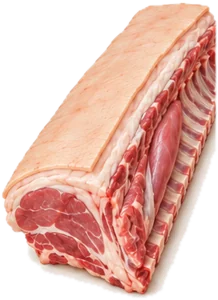
The calculation starts with the prices packers report each day for individual items. In the plant, a primal such as the loin is processed into smaller cuts. The cutout calculation works backward from the prices of those cuts, adjusting for yields and labor costs to estimate the primal's value. The figure below follows the calculation from loin cuts to the loin value and then to the carcass cutout.
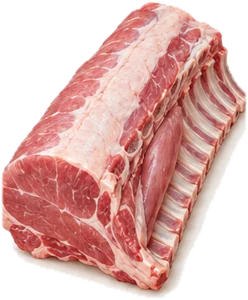 Bone-In CC, Tender-In Loin
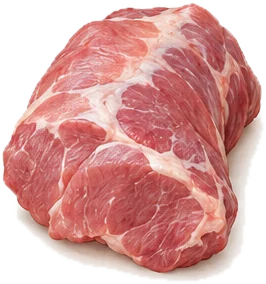 Sirloin
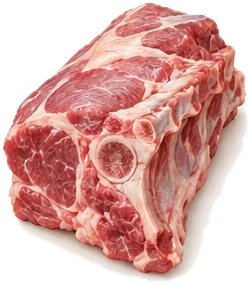 Blade Ends
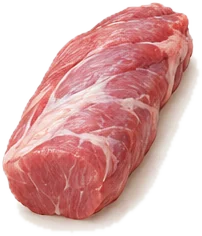 Butt Tender
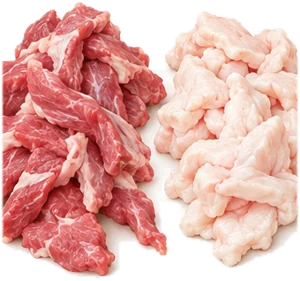 Trimmings
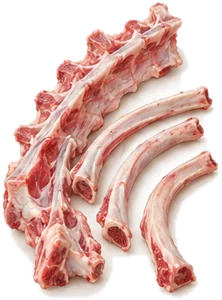 Bone
BoneSteps ① to ③ produce the value of one primal (the loin). Step ④ combines the six primals and the remaining items, weighted by carcass yield, into the carcass cutout. The same procedure applies to the butt, picnic, ham and the other primals.
The six primals
The USDA publishes values for six primals every day. In the carcass cutout, each primal value is weighted by its share of carcass weight (its yield).
| Primal | Share of carcass | Closest Japanese cut |
|---|---|---|
| Loin | 25.23% | ロース・ヒレ (rōsu, hire) |
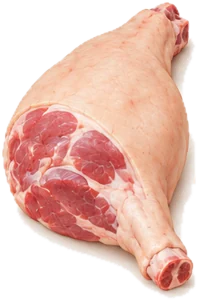
| Ham | 24.68% | モモ (momo) |
| Belly | 16.22% | バラ (bara) |
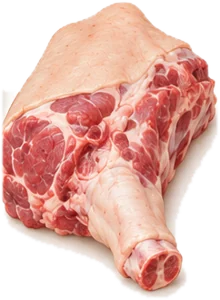
| Picnic | 11.23% | ウデ (ude) |
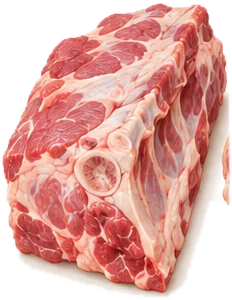
| Butt | 10.03% | 肩ロース (kata-rōsu) |
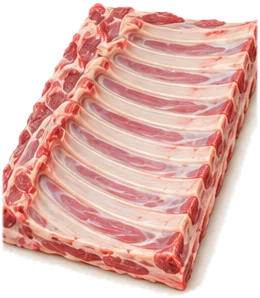
| Sparerib | 4.55% | スペアリブ (spare rib) |
The remainder consists of jowl (about 1.5%), neck bones (about 1.9%) and other items such as feet, tail and cut loss (about 4.7% combined), bringing the total to 100% of the carcass. The Japanese cuts are approximate equivalents only; because specifications and yields differ, values cannot be converted one to one.
Carcass cutout and packer margins
In effect, an average wholesale price
Weighting the six primals by these shares gives the carcass cutout, also called the composite cutout. Unlike a transaction price in Japan's wholesale carcass markets, it estimates a packer's average revenue per unit of carcass weight when the carcass is sold as cuts.
The spread: a gauge of packer margins
Because the carcass cutout is quoted per 100 lb of carcass, it can be compared directly with hog prices on a carcass basis. The difference between the two (cutout minus hog price) is known as the spread, and the industry widely uses it as a gauge of packer margins.
The spread also includes processing costs such as slaughter and cutting labor and yield losses. As long as those costs stay roughly constant, changes in the spread reflect changes in profit (see figure).

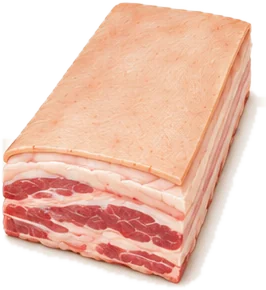
The spread over time is available on the Macro & analysis dashboard.
Data source
- The cutout and primal values section of the USDA AMS report National Daily Pork Report FOB Plant – Negotiated Sales – Afternoon (LM_PK602)
- Final values are published around 2 p.m. U.S. Eastern Time on business days
- Prices are quoted in USD per hundredweight (USD/cwt; 1 cwt = 100 lb ≈ 45.36 kg). No report is published on weekends
Coverage and limitations
Negotiated, near-term trades only
The daily cutout includes only negotiated sales, in which the packer and buyer agree on a price directly, for delivery within 14 days of the day after the agreement for boxed product, or within 10 days for combos (product packed loose in large bins). Sales for later delivery (forward sales) and sales priced by a formula linked to market prices appear in separate weekly reports. Export sales are also excluded from the daily cutout and published in a separate weekly report (Export Sales).
Specifications can vary within an item
Packers report each cut under the USDA item it most closely matches, so products reported under the same item can still differ slightly in trim and specification between packers and customers. The item-level prices used in the cutout reflect these differences.
Common misconceptions
- ✕“The cutout value is the spot price of carcasses”
It is not a price for the carcass itself. It indicates the wholesale value of a carcass sold as cuts, per 100 lb of carcass.
- ✕“A primal value is the price at which that primal trades”
Whole primals such as the loin do not trade at that price. What trades are the individual cuts trimmed from them; the primal value is derived from their prices.
The data in this article is available on these dashboards.
Drafted with AI under the direction of our editor, who reviewed and edited every section.