Japan's Pork Safeguards
Emergency tariff increases on pork imports
A safeguard is an emergency measure that temporarily raises tariffs when imports surge, to protect domestic industry. Japan's pork safeguards are more complex than those for other products because they operate alongside the gate price system, under which the duty burden gets heavier as import prices fall (see Japan's Gate Price System).
What a safeguard is
Trade liberalization exposes domestic producers to the risk of import surges. A safeguard lets a country temporarily raise tariffs or limit quantities in response. It is based on WTO rules (GATT Article XIX and the Agreement on Safeguards).
- It is applied after an investigation establishes that the surge has caused, or threatens, serious injury to a domestic industry.
- It applies to imports from all countries alike.
- It is temporary, and trading partners may seek compensation or retaliate.
Special safeguards for agricultural products
Agricultural products also have a special safeguard (SSG) that is easier to trigger. It covers products whose quotas and other import restrictions were converted into tariffs (tariffication) in the Uruguay Round and for which the right to use an SSG was reserved.
| General safeguard | Special safeguard (SSG) | |
|---|---|---|
| Legal basis | GATT Article XIX; Agreement on Safeguards | WTO Agreement on Agriculture, Article 5 |
| Coverage | All goods | Only agricultural products for which the right to use an SSG was reserved at tariffication |
| Proof of injury | Required (investigation and causation) | Not required (automatic once volume or price passes a threshold) |
| Measures | Higher tariffs; quantity limits also possible | Additional duties only |
| Compensation and retaliation | Possible | None |
The key feature of the SSG is that it is triggered automatically, without proof of injury, once a preset threshold is passed. Japan's SSG products include dairy products, wheat, barley, beans and starch; pork is one of them (volume-based only).
Why pork is a special case
Even among meats, safeguards differ in whether they exist and how they work.
The beef safeguard simply raises the tariff rate. For pork, when the WTO safeguard is triggered, the ad valorem duty rises by a third, to 5.7%, and the standard import price is raised so that the gate price stays the same. Both safeguards are triggered automatically without proof of injury; what is unique to pork is that the whole duty schedule rises while the gate price of the differential duty stays fixed.
Normally the gate price is ¥524/kg and the standard import price is ¥546.53/kg (pork cuts; see Japan's Gate Price System). When the WTO safeguard is triggered, the gate price stays at ¥524/kg and the standard import price rises to ¥553.87/kg.
Pork has two safeguard systems
Two safeguards with different origins exist side by side for pork.
- WTO safeguard — In place since Japanese fiscal year (JFY) 1995, when pork was tariffied under the Uruguay Round; it raises duties when imports surge. (Japan's fiscal year runs from April to March.) Imports from all origins count toward the trigger, but the higher duties apply only to imports not using EPA/TPP rates (imports outside the agreements).
- Agreement safeguards — Added under each trade agreement as it took effect. They raise duties previously reduced under the agreement when imports from a given partner exceed a threshold.
WTO safeguard: triggers and measures
The WTO safeguard (Article 7-6 of the Act on Temporary Measures concerning Customs) compares cumulative imports for the fiscal year (starting in April) with a preset trigger volume. It is triggered only when two conditions are met at the same time.
Exceeding only one of the two does not trigger it
The trigger volume is based on average imports over the past three years and is published by Japan Customs each fiscal year (for pork, roughly 105% of the average plus the change in consumption).
The test covers “pork and pork products” as a whole, from live hogs to processed products, not individual tariff lines.
This chart also appears under “Pork safeguard tracker” on the Japan imports dashboard and is updated with each monthly release from Japan Customs. The safeguard is triggered when the plotted point enters the upper-right zone, where both import totals exceed 100% of their trigger volumes.
When triggered, the ad valorem duty rises from 4.3% to 5.7%, and the standard import price is raised to ¥553.87/kg so the gate price stays the same (pork cuts). The statutory specific duty rises to ¥642.67/kg (four-thirds of ¥482). Because this exceeds the standard import price, no import price falls within the specific duty band; the differential duty applies instead.
| Normal | When triggered | |
|---|---|---|
| Gate price | ¥524/kg | ¥524/kg (unchanged) |
| Ad valorem duty | 4.3% | 5.7% |
| Standard import price | ¥546.53/kg= 524 × (1 + 4.3%) | ¥553.87/kg= 524 × (1 + 5.7%) |
| Specific duty | ¥482/kg (import prices of ¥64.53/kg or less) | Merged into the differential duty (see note) |
Note: On a carcass basis, the standard import price rises from ¥409.90/kg to ¥415.40/kg and the gate price stays at ¥393/kg (the statutory specific duty rises from ¥361/kg to ¥481.33/kg, but the differential duty applies instead, as for pork cuts). The higher duties apply from the first day of the second month after the trigger volume is exceeded until the end of the fiscal year.
Note: The specific duty applies only to import prices at or below the standard import price minus the specific duty. When the safeguard is triggered, that is 553.87 − 642.67 = −¥88.80/kg, a negative price (the Customs Training Institute's explanation likewise shows −¥65.93/kg for carcasses). So the specific duty band merges into the differential duty, and all imports at ¥524/kg or below pay the differential duty (¥553.87/kg minus the import price).
The one-third increase is the maximum additional duty allowed under the special safeguard of the WTO Agreement on Agriculture (up to one third of the ordinary duty).
Agreement safeguards: triggers and measures
Triggers by agreement, partner and price tier
The agreement safeguards (Article 7-8) are tested for each partner country under each agreement. Pork is managed in two tiers, split at an import price of ¥399/kg (the reference price).
¥399/kg equals the ¥524/kg gate price minus the ¥125/kg specific duty that applied in years 1–4 of the agreements, so the tiers appear to have been drawn around the specific duty band of those years. There is no official explanation; this is our inference.
- At or above the reference price — ¥399/kg and above (statistical codes ending in 025 or 022)Tested for each country, against a trigger of 119% of the highest annual imports from that country in the past three years (JFY2024–2028).
- Below the reference price — under ¥399/kg (codes ending in 024 or 023)A single fixed trigger volume applies to all partner countries combined.
Note: The codes are the last three digits of Japan's 9-digit statistical codes for pork (0203). For carcasses the reference price is ¥299.25/kg (the ¥393/kg carcass gate price minus the ¥93.75/kg specific duty of years 1–4), with codes 032 and 040 (at or above) and 031 and 020 (below). Offal (0206.30, 0206.49) is split at the same ¥399/kg.
Trigger volumes and fiscal-year-to-date imports by agreement and partner:
This chart also appears under “Pork safeguard tracker” on the Japan imports dashboard and is updated with each monthly release from Japan Customs. Japan–UK volumes include EU-origin pork and UK pork under CPTPP, as counted by Japan Customs.
Imports below the reference price are rare and remain well below the trigger volumes (table below). In practice, this tier poses little risk of a safeguard being triggered.
Both parts of the duty rise
When a safeguard is triggered, duties previously reduced under the agreement increase. Pork tariffs under these agreements have an ad valorem component (a percentage of the import price) and a specific duty component (a fixed amount per kilogram). The safeguard raises both.
- Ad valorem component — normally falls in steps from 4.3% to zero; when triggered, it rises to 4.0%, 3.4%, 2.8% or 2.2%, depending on the year.
- Specific duty component — normally falls from ¥482/kg to ¥50/kg; when triggered, it rises to ¥100/kg or ¥70/kg.
| Year | Now12018 | Now22019 | Now32020 | Now42021 | Now52022 | Now62023 | Now72024 | Now82025 | Now92026 | Now102027 | Now112028 | Now122029 |
|---|---|---|---|---|---|---|---|---|---|---|---|---|
| Ad valorem component (%) | ||||||||||||
| Normal | 2.2% | 1.9% | 1.7% | 1.4% | 1.2% | 0.9% | 0.7% | 0.4% | 0.2% | 0% | 0% | 0% |
| When triggered | 4% | 4% | 4% | 3.4% | 3.4% | 3.4% | 2.8% | 2.8% | 2.8% | 2.2% | 2.2% | – |
| Specific duty component (¥/kg) | ||||||||||||
| Normal | 125 | 125 | 125 | 125 | 70 | 66 | 62 | 58 | 54 | 50 | 50 | 50 |
| When triggered | – | – | – | – | 100 | 100 | 100 | 100 | 100 | 70 | 70 | – |
All agreement safeguards end after year 11
Each agreement's safeguard remains available through year 11 and ends in year 12. For the CPTPP and the Japan–EU EPA, year 11 is JFY2028 (April 2028 to March 2029), after which the safeguard is abolished. The Japan–US and Japan–UK agreements appear to follow the same timeline.
Case study: which imports face higher duties when imports rise
Japan Customs tallies pork imports in two groups: imports at EPA/TPP rates and imports outside the agreements. Higher duties under the WTO safeguard apply only to imports outside the agreements (Brazilian pork, for example). Duties on imports at EPA/TPP rates rise only when a partner exceeds its own trigger volume under an agreement safeguard.
Actual figures as of the end of August, JFY2026. Only the UK's CPTPP trigger volume has been exceeded, so the only imports paying a higher duty are UK pork imported at CPTPP rates.
How the figures are published
Every month, Japan Customs publishes on its safeguard page the cumulative imports since the start of the fiscal year, the trigger volumes and the gap between them. The WTO safeguard figures appear in a table on imports of pork and pork products and the agreement safeguards in a table on imports of items subject to tariff modification (both in Japanese). The actual releases look like this:
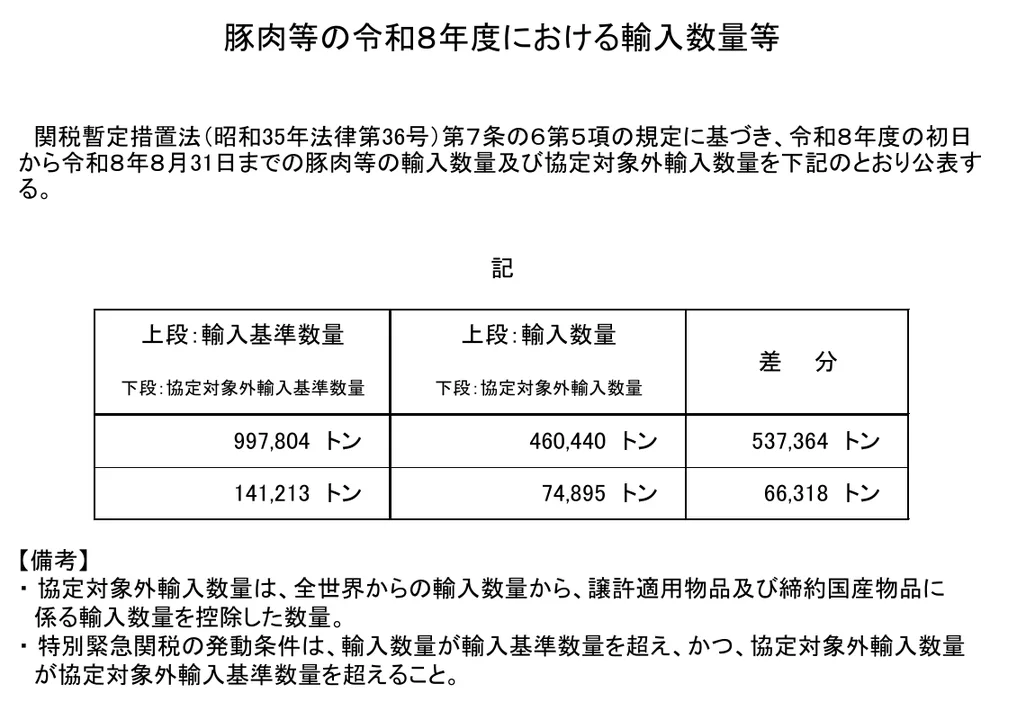
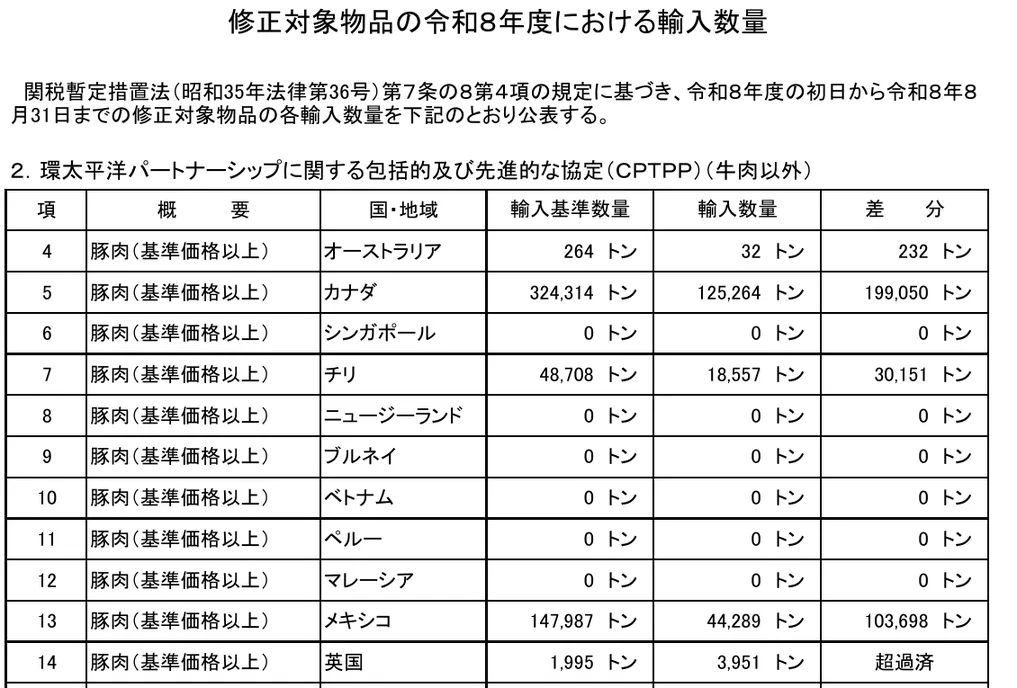
Trigger volumes are set at the start of the fiscal year (end of March; some at the end of May), and cumulative imports are updated monthly through the year. Anyone can follow the same figures.
Past triggers
Japan's WTO safeguard on pork has not been triggered since JFY2005. Before that, under an older measure tested quarterly (the tariff emergency measure), it was triggered seven times in JFY1995–2004, raising the standard import price to ¥681.08/kg (pork cuts). The agreement safeguards have not been triggered for pork from Japan's main suppliers either.
The two-condition test seen above helps explain why the WTO safeguard has not been triggered in recent years. Since the current system began in JFY2020, imports have sometimes exceeded one of the two trigger volumes, but never both in the same fiscal year.
| ① All origins | ② Outside agreements | Triggered | |
|---|---|---|---|
| JFY2020 | 90% | 231% | No |
| JFY2021 | 94% | 20% | No |
| JFY2022 | 98% | 108% | No |
| JFY2023 | 94% | 186% | No |
| JFY2024 | 100% | 93% | No |
| JFY2025 | 92% | 178% | No |
For comparison, the beef safeguard was triggered in 2021. Under the Japan–US Trade Agreement, the duty on U.S. beef rose from 25.8% to 38.5% from March 18 to April 16, 2021, because cumulative imports for JFY2020 exceeded the trigger. For beef, only the ad valorem rate rises; for pork under the WTO safeguard, the standard import price also rises while the gate price stays fixed.
Key points
- Pork has two safeguards: the WTO safeguard, a permanent measure that applies to imports outside the agreements, and the agreement safeguards, applied by agreement and partner through year 11.
- What is unique to pork is that when the WTO safeguard is triggered, the gate price stays at ¥524/kg while the standard import price and the ad valorem duty rise.
- The WTO safeguard has not been triggered since JFY2005, but if domestic prices rise while import prices fall and import volumes grow, cumulative imports can approach the trigger volume, so import trends are worth watching.
How we read the rules
Japan's pork safeguards are hard to follow because two systems run side by side, and no single document explains how they fit together. The relevant provisions are spread across the law, Japan Customs' monthly releases and MAFF briefings. We reconciled them to reach the reading used in this article. The original texts and the step-by-step reasoning are in the Japanese version of this section.
Imports are split into those entered at EPA/TPP rates and those outside the agreements.
Based on: Act on Temporary Measures concerning Customs, Article 7-6(1), proviso (Japanese)
The WTO safeguard is triggered only when both imports from all origins and imports outside the agreements exceed their trigger volumes.
Based on: Japan Customs, monthly release on pork and pork products (notes) (Japanese)
Agreement safeguards are tested separately for each agreement and partner, and only the partner that exceeds its trigger volume faces higher duties.
Based on: Act on Temporary Measures concerning Customs, Article 7-8(1); Japan Customs, monthly release on items subject to tariff modification (Japanese)
The WTO safeguard does not apply to imports at EPA/TPP rates.
Based on: MAFF, Pork tariffs under the TPP (phased reductions and safeguards) (Japanese)
The agreement safeguards end after year 11; the WTO safeguard continues.
Based on: MAFF, Pork tariffs under the TPP (phased reductions and safeguards) (Japanese)
The March 2020 change
Until March 2020, Japan's WTO safeguard on pork consisted of two measures. What the Japanese trade knows as the “119% rule” is the one abolished in March 2020, the tariff emergency measure. It differed from today's special emergency tariff (Article 7-6) both in how it was triggered and in what it did. The agreement safeguards also use 119%, but as a multiple of each country's highest annual imports in the past three years, and that rule is still in force (see above).
| Tariff emergency measure (abolished March 2020) | Special emergency tariff (today's WTO safeguard) | |
|---|---|---|
| Trigger | Cumulative imports from the start of the fiscal year exceeding a quarterly threshold of 119% of the average for the same period in the previous three years | Fiscal-year-to-date imports above the trigger volume published each year by Japan Customs |
| Measure | Standard import price returned to the bound level (pork cuts ¥546.53 → ¥681.08/kg; gate price ¥524 → ¥653/kg) | Ad valorem duty raised by a third (4.3% → 5.7%); standard import price raised from ¥546.53 to ¥553.87/kg, leaving the gate price unchanged |
| Triggers | Seven times, JFY1995–2004 | Last in JFY1996 |
| From April 2020 | Not extended; expired | Continues as Article 7-6 |
From the CPTPP's entry into force in December 2018, the old measure was also tested against two conditions — imports from all origins and imports outside the agreements — like today's system.
The old measure had been extended every year, but it was not extended in the FY2020 tariff revision and expired on March 31, 2020. By then more than 99% of Japan's beef and pork imports came from EPA partners or the United States and were covered by those agreements' safeguards. The Japan–US Trade Agreement brought U.S. beef and pork under its safeguards in January 2020, leaving virtually no imports subject to the old measure. The seven triggers in JFY1995–2004 (see Past triggers) were under this old measure. The original texts are in the Japanese version of this section.
The data in this article is available on this dashboard.
- Japan Customs — Safeguards: system and monthly releases (Japanese)
- Japan Customs — Products subject to safeguards (Japanese)
- Act on Temporary Measures concerning Customs (e-Gov; Japanese)
- MAFF — Border measures for pork: differential duty and safeguard prices (Japanese)
- MAFF — Pork tariffs under the TPP and other agreements: phased reductions and safeguards (Japanese)
- MAFF — Japan–EU EPA: pork (Japanese)
- WTO — Agreement on Safeguards
- WTO — Agreement on Agriculture (special safeguard: Article 5)
- ALIC — Annual report 2005, pork: triggers of the tariff emergency measure (Japanese)
- House of Councillors, Financial Affairs Committee research office — Overview of the FY2020 tariff revision (February 2020; Japanese)
- Ministry of Finance — Outline of the 2020 bill amending the Customs Tariff Act (Japanese)
- Customs Training Institute — Act on Temporary Measures concerning Customs (FY2025; Japanese)
- JAcom — Beef safeguard triggered under the Japan–US Trade Agreement (March 2021; Japanese)
Drafted with AI under the direction of our editor, who reviewed and edited every section.